
Many people know that the American Dental Association recommends visiting your dentist every six months to prevent dental concerns, such as cavities, gum disease, and even oral cancer. These routine preventive visits allow them to monitor your condition and treat any areas of concern before they progress.
But were you already aware that many providers also take X-rays at least once annually? If you’re unsure why this kind of imaging is needed to help care for your smile, continue reading to learn more about it!
Why Does My Dentist Take X-rays?
Your dentist undergoes years of education and training to gain the knowledge and experience needed to help identify dental problems and provide customized treatment plans to address them. But when it comes to your teeth, there are plenty of problems that can develop or extend beneath the surface that can’t be seen with the naked eye.
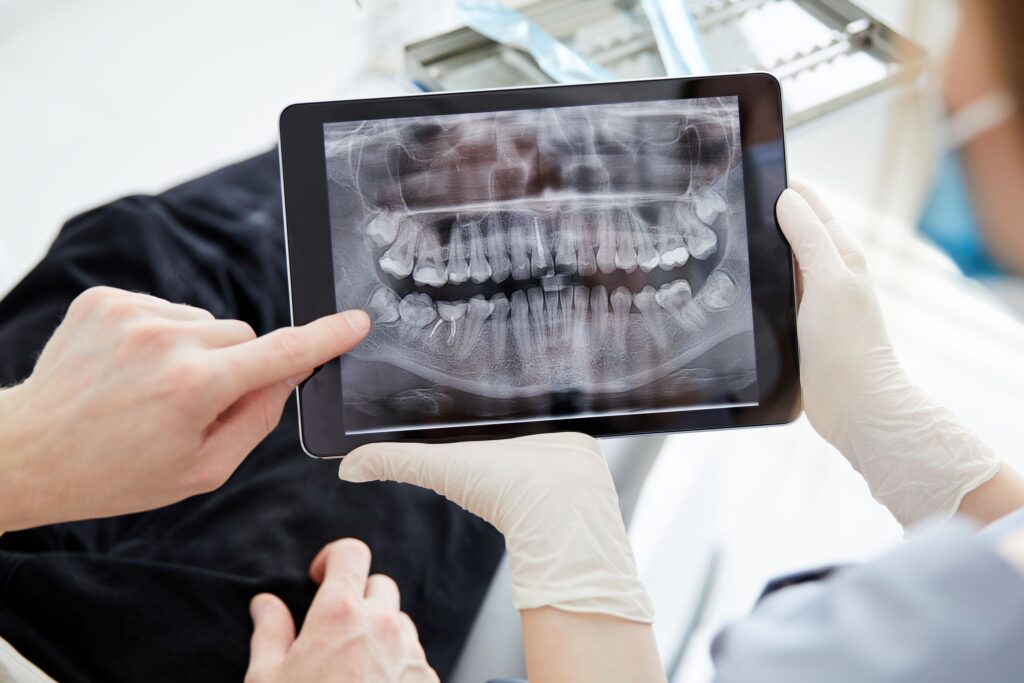
Dental X-rays help your provider view the internal structures of your teeth and jawbone to identify hidden issues, such as infections, decay, orthodontic misalignments, and other issues. This gives them a more comprehensive picture of your oral health, so they can help prevent serious concerns that might otherwise go unnoticed.
What Are the Different Types of Dental X-rays?
There are several types of X-rays that your provider might use. For instance, some images are therapeutic in nature and are intended to help with proper prevention. Others are diagnostic and are required when you have an issue, like a toothache, and additional assessment is needed to identify the root problem.
Some of the different kinds of X-rays and their intended purposes are outlined in more detail below:
- Bitewing. This requires biting onto a special type of paper that allows your dentist to see how well the biting surfaces of your teeth match up, and is often used to help check for cavities between two teeth.
- Occlusal. These images are done with a closed jaw to view how well your upper and lower arches line up, and can help detect abnormalities in the palate (roof of the mouth) or the floor of your mouth.
- Panoramic. This involves biting onto an anchoring device to help keep you still while a special machine rotates around your head to generate a complete view of your teeth, jawbone, and bite alignment. These scans can be helpful for investigating jaw-related problems, detecting wisdom teeth, and helping with implant placement.
- Periapical. This method focuses on capturing more detailed, root-to-crown internal pictures of your teeth.
If you’re unsure about the types of imaging your provider intends to use, or why it may be required, you can learn more by contacting their office directly!
About the Practice
Patients at Eley Family Dentistry benefit from two accomplished dentists with 20+ years of combined experience. Drs. Daniel and Joel Eley are brothers who collaborate to offer a comprehensive menu of services to meet your unique needs under one roof, including preventive visits and X-rays. They combine a caring, compassionate approach with state-of-the-art equipment to help you feel comfortable while delivering customized treatment plans for accurate, lasting results. You can request an appointment on the website or by calling (321) 622-8711.